Why BIM data is worth less on the balance sheet than the industry thinks
Summary
BIM data can be recognised on the balance sheet, but almost always only at what it cost to produce. That is often a small fraction of the value the industry attributes to it. “Data is the new gold” is a claim about what data can do for an organisation, while accounting asks what an organisation may report as an asset, and the two answers differ.
Three things keep the booked value low.
- Accounting rules start from cost for intangible assets. IFRS (IAS 38), US GAAP, US public-sector rules (GASB 51), the national GAAPs of EU countries (such as HGB in Germany and RJ 210 in the Netherlands), UK GAAP (FRS 102), and the rules in Japan, China and Australia all do, and expected benefits do not raise the carrying amount.
- BIM data has no second-hand market. Without an active market, the revaluation model is not allowed and there is no fair value to refer to, which leaves cost as the only measurable anchor.
- The relevant cost is small. Only the directly attributable cost of the data counts. Once the design is known, rebuilding a model takes hours to weeks of work, and the full design fee does not count.
Who made the data matters too. Data handed over by a designer or contractor was bought, and can be recognised at cost everywhere. Data made by the owner's own staff faces stricter rules, and in some countries, such as Austria, it cannot be recognised at all.
The benefits show up in the profit and loss account as lower maintenance cost, fewer failures and faster decisions, rather than as a line under intangible assets.
Why it matters
Owners push for balance-sheet recognition because what is on the balance sheet gets an owner, a budget and an annual check. Data that is expensed disappears from view in the year it is paid for, and after that nobody pays to keep it current.
The argument backfires when the expectation is too high. A BIM manager who tells the CFO the model is “worth millions” and then sees the controller book a few thousand euros, or nothing, loses credibility for the whole data programme. If you know in advance what accounting allows, you can make the case with numbers that survive an audit:
- The booked value is small and based on cost. It gives the data a place in the asset register, an amortisation schedule and an impairment test.
- The value in use can be large. It belongs in the business case and the maintenance budget, and has no place in the note on intangible assets.
What accounting rules allow, internationally
Every major framework measures intangible assets at cost first, and none lets an owner write BIM data up to what it is expected to save. That holds for listed and non-listed companies, for public bodies, and from Europe and the Americas to Asia-Pacific. The frameworks differ mainly in how they treat data an organisation makes itself.
Handed over or made in-house?
The first question for any model is who made it. Most owners receive their models from a designer or contractor, and for them the rules are simpler than the long list of national differences below suggests.
- The data was bought, so it is an acquired intangible asset.
- It can be recognised at cost under every framework on this page: its share of the contract price, or the measured rebuild cost when the contract does not split that share out.
- That cost usually sits inside the asset's cost already, so recognising the data carves out a slice and adds no value.
- The development-phase test, the German dividend block, the Dutch legal reserve and the Austrian ban do not apply, and German municipalities can recognise it too.
- The data is internally generated, and only the cost of the development phase can qualify.
- US GAAP and Japanese GAAP mostly expense it.
- Austria (UGB § 197(2)) and German municipalities do not allow it on the balance sheet at all.
- Germany (HGB § 268(8)), the Netherlands (legal reserve), Spain, Italy and the UK restrict dividends against it.
Data received for nothing, for example from a developer, is a third case: public bodies recognise it at its fair value on the day it is received (IPSAS 31), or at its acquisition value under GASB.
The common logic
To appear on a balance sheet as an intangible asset, BIM data has to pass three tests under IAS 38 and its equivalents:
- The data must be identifiable: it can be separated from the building (sold, licensed, transferred), or it arises from a contract. An IFC file usually passes.
- The owner must control it, meaning it has the rights to use the data and can stop others from using it. Contract terms on model ownership and licences decide this.
- Future benefits must be probable and the cost reliably measurable. A maintained model usually meets the benefit test. The cost test is harder, because a model is rarely invoiced as a separate line.
A model that passes goes onto the balance sheet at cost. It is then amortised over its useful life and tested for impairment. The expected savings serve only as a ceiling in that impairment test and are never used as a starting value.
Framework by framework
| Framework | Used by | Initial measurement | Can it be revalued upwards? | What limits BIM data in practice |
|---|---|---|---|---|
| IFRS: IAS 38 (+ IAS 36 impairment) | Listed companies in the EU, the UK and 140+ jurisdictions; many large contractors and infrastructure operators | Cost | Only if fair value can be determined by reference to an active market; the standard calls this rare | No active market for BIM data, so the cost model is the only option |
| US GAAP: ASC 350 | US companies | Cost; internally developed intangibles are mostly expensed as incurred | No. Revaluation is prohibited | Purchased data at cost; data created in-house rarely qualifies at all |
| US public sector: GASB 51 | US states, counties, cities, transport agencies | Historical cost; internally generated only after objective, feasibility and commitment are shown | No | Local capitalisation thresholds; outlays before the conditions are met are expensed |
| IPSAS 31 (+ IPSAS 21 impairment) | Public bodies in many countries outside the US, international organisations | Cost | Only with an active market, as IAS 38 | Same as IFRS; impairment uses service potential instead of cash flows |
| EU national GAAP, based on the EU Accounting Directive (for example HGB in Germany, the PCG in France) | Non-listed companies across the EU | Purchase price or production cost; whether self-made intangibles may be capitalised at all is a national choice | Revaluation is a national option, rarely open to intangibles; German HGB does not allow it | Where development costs are capitalised, the Directive restricts dividends until they are written off; Germany blocks distribution of the same amount |
| Dutch GAAP: BW2 art. 365 + RJ 210 | Dutch companies (most non-listed); the Dutch version of the EU Directive | Cost | Only with an active market | Self-made data only: capitalised development costs require a legal reserve of the same amount, which blocks distribution of that equity |
| UK GAAP: FRS 102, Section 18 | Most UK private companies (micro-entities use FRS 105) | Cost; capitalising development costs is a policy choice | Only with an active market | At most ten years if the useful life cannot be estimated reliably; capitalised development costs count as a realised loss for dividends |
| Japan: J-GAAP (ASBJ) | Most Japanese companies; listed groups may choose IFRS instead | Cost; research and development costs are expensed, internal-use software is capitalised when it reliably saves cost | No | Data built in-house is mostly expensed; capitalised software is usually amortised within five years |
| China: CAS 6 + data resources rules (2024) | Chinese enterprises | Cost; since January 2024 data resources can be recognised as intangible assets or as inventory | No | The first rules written for data, and still at cost, with extra disclosure about the data held |
| Australia: AASB 138 | Companies, not-for-profits and the public sector alike | Cost | Only with an active market, as IAS 38 | Same as IFRS; the same standard applies to government agencies |
Europe, country by country
Listed groups across the EU and the UK report under IFRS. Everyone else follows national rules, and those differ more than the shared EU Accounting Directive suggests: in some countries data the owner made itself can go on the balance sheet, in others it never can. Who made the data matters. A model bought from a designer or contractor is an acquired intangible everywhere, at its share of the contract price; a model built by the owner's own staff is self-made, and that is where the countries part ways. None of them lets the data be written up to what it is expected to save.
| Country | Rules for non-listed companies | Self-made data on the balance sheet? | Once it is there |
|---|---|---|---|
| Germany | HGB (Handelsgesetzbuch) | Optional (§ 248(2)), and only the cost of the development phase (§ 255(2a)); never in the tax balance sheet (EStG § 5(2)) | Amortised over ten years if the useful life cannot be estimated reliably (§ 253(3)); the same amount is blocked for dividends (§ 268(8)); no revaluation |
| Austria | UGB (Unternehmensgesetzbuch) | No. Intangibles that were not bought may not be recognised (§ 197(2)) | Bought data at cost, amortised; no revaluation |
| Netherlands | BW2 Title 9 and RJ 210 | Optional for development costs | A legal reserve of the same amount; revaluation only with an active market |
| France | PCG (Plan comptable général) | Optional; capitalising is the reference method, and once chosen it cannot be reversed | The free revaluation of fixed assets does not extend to intangibles |
| Spain | PGC (Plan General de Contabilidad) | Required once the conditions are met | Useful life presumed to be five years at most; dividends restricted until reserves cover the capitalised amount |
| Italy | Civil Code art. 2426 and OIC 24 | Allowed for development costs, with the consent of the board of statutory auditors | Amortised within five years if the useful life cannot be estimated; dividends only if reserves cover the unamortised amount |
| Sweden | K2 and K3 (Bokföringsnämnden) | Not under K2, used by smaller companies; allowed under K3 | The amount is moved into a restricted development fund in equity |
Germany: public owners
German municipalities that keep double-entry accounts (Doppik) follow their state's municipal budget regulations, and these can be stricter than the HGB. Bavaria's KommHV-Doppik § 72(4), for example, forbids recognising intangible fixed assets that were not bought. A model paid for under a design or construction contract was bought, so it can be recognised at its share of the contract cost; a model the municipality's own staff built cannot. The federal budget and most states still use cash-based (cameral) accounting, which has no balance sheet for data at all. Publicly owned infrastructure companies, such as Die Autobahn GmbH des Bundes, are companies and report under the HGB like any other.
United Kingdom
- Listed groups report under UK-adopted IFRS, so IAS 38 applies as described above.
- Most private companies use FRS 102, Section 18. Capitalising development costs is a policy choice, and once chosen it applies to every project that meets the conditions. Revaluation needs an active market. If the useful life cannot be estimated reliably, it may not exceed ten years. Under the Companies Act 2006, s. 844, capitalised development costs count as a realised loss when working out what can be paid as dividends, unless the directors can justify otherwise.
- Micro-entities use FRS 105, which does not allow development costs to be capitalised at all.
- Central government follows the FReM. From 2025-26 the revaluation model for intangible assets has been withdrawn, so data is held at historical cost.
- Local authorities follow the CIPFA Code, which is based on IAS 38: revaluation only with an active market, so in practice historical cost.
The cost is usually already on the books
When an owner commissions a building or a bridge, the design and engineering fees are part of the cost of the physical asset. IAS 16 includes “any costs directly attributable to bringing the asset to the location and condition necessary” for its use, and that includes professional fees. US GAAP, GASB and the national GAAPs in Europe, the UK, Japan, China and Australia work the same way.
So the model's cost is normally already capitalised inside the building and depreciated with it. Recognising the data separately carves a slice out of that cost and adds no new value. The total on the balance sheet stays the same, and the data slice gets its own useful life and impairment test.
The IASB review of intangibles
The IASB has a comprehensive review of IAS 38 on its work plan, looking at user needs and at definition and recognition. Its next milestone is a decision on project direction. Nothing in it so far proposes fair-value recognition of data, and any change would take years to reach annual reports.
China: the first rules written for data
Since 1 January 2024, Chinese enterprises can recognise data resources on the balance sheet, as an intangible asset under CAS 6 or as inventory when the data is held for sale. It is the clearest signal yet from a standard-setter that data can be an asset. The measurement basis did not change: data goes on the balance sheet at cost, and the new rules mainly add disclosure about the data an enterprise holds.
No second-hand market, so cost is the only anchor
BIM data has no market price, and that rules out every route to a higher booked value. A revaluation needs an active market, with homogeneous items, willing buyers and sellers at any time, and public prices. An IFC model of one building on one site meets none of these conditions.
- Nobody buys someone else's model on its own. A model is bespoke to one asset, one site and one owner, and it changes hands only together with the asset, a concession or a maintenance contract.
- There are no observable prices. When a model is transferred, the price is negotiated privately and buried in a larger deal.
- A buyer pays for its own alternative. An incoming maintenance contractor pays at most what it would cost to get the facts another way, minus the effort of checking and converting your file. What the seller spent does not enter into it.
Under the rules, this has four consequences:
- Fair value less costs to sell (in Dutch: opbrengstwaarde) is effectively nil.
- The revaluation model is not available under IFRS, IPSAS, AASB 138, FRS 102 or the EU national GAAPs, and US GAAP, J-GAAP and China's CAS 6 do not allow it for any intangible.
- The recoverable amount, the ceiling in the impairment test, is therefore set by value in use alone.
- The only measurable starting point left is cost: what was paid for the data, or what it would cost to produce it again.
Buildings are different. Office space has rents, yields and transactions, so a property can be measured at fair value under IAS 40.
The eleven numbers that get called “the value of the data”
The Valuation tab in forensicBIM shows eleven numbers, plus origination cost off the ladder, because people mean very different things by “value”. The numbers differ by a factor of 1,000 or more. Only the carrying amount is a balance-sheet figure, and it is one of the smallest.
The numbers fall on two sides:
- The cost side asks what it would take to get the information back if it were lost tonight.
- The utility side asks what the data saves or earns for whoever holds it.
The two sides meet in deprival value, the lower of re-acquisition cost and value in use. An owner would never lose more than it costs to replace the data, and would never spend more to replace it than it is worth to keep.
| # | Number | The question it answers | Side | On the balance sheet? |
|---|---|---|---|---|
| 1 | Value at stake | How much money depends on this data being right? | Exposure | No; it is context, not worth |
| 2 | Value in use | What does the holder save over the data's service life? | Utility | No; used only as an impairment ceiling |
| 3 | Recoverable amount | Which is higher: selling it or keeping it? | Utility | Ceiling for the carrying amount (IAS 36, IPSAS 21) |
| 4 | Re-acquisition cost | What would it cost to re-measure the built asset (scans, surveys, openings)? | Cost | No |
| 5 | Deprival value | What would we lose without it? | Where both sides meet | No |
| 6 | Current cost | What would an equivalent dataset to today's standard cost? | Cost | Only as a measurement base in some public-sector regimes |
| 7 | Depreciated replacement cost | Current cost less obsolescence (gaps in data, age) | Cost (measured) | Supports the figure at recognition |
| 8 | Reproduction cost | How many hours to rebuild this file, with the answer known? | Cost (measured) | Lowest defensible cost at recognition |
| 9 | Transfer value | What would a second party pay? | Cost (measured) | No; there is no market to confirm it |
| 10 | Carrying amount | What is on the books? | Cost | Yes: recognised cost less amortisation, often €0 |
| 11 | Net realisable value | What would it fetch on an open market? | Utility | Effectively nil |
| — | Origination cost | What did the design cost? | Off ladder | Belongs to the design, already inside the building's cost |
Three things in this table explain the gap between what people feel and what the books show:
- The large numbers sit on the utility side. Value at stake and value in use are what people mean when they say “data is gold”, and accounting uses value in use only as a cap.
- Net realisable value is nil. With no market, the recoverable amount collapses onto value in use, and fair value cannot be used.
- The carrying amount is the recognised cost, amortised. It stays at €0 unless the owner deliberately recognises the data, and even then it starts at the attributable cost and falls every year.
forensicBIM keeps origination cost off the ladder. The design fee pays for solving the engineering problem, and drawings, specifications and the IFC model all record the same decisions, so attributing the full fee to the model would count it several times.
Worked examples
In a real ten-apartment model, the value at stake runs into millions, while the most the model could carry on the balance sheet is about €2,800.
Example 1: ten apartments, one architectural model
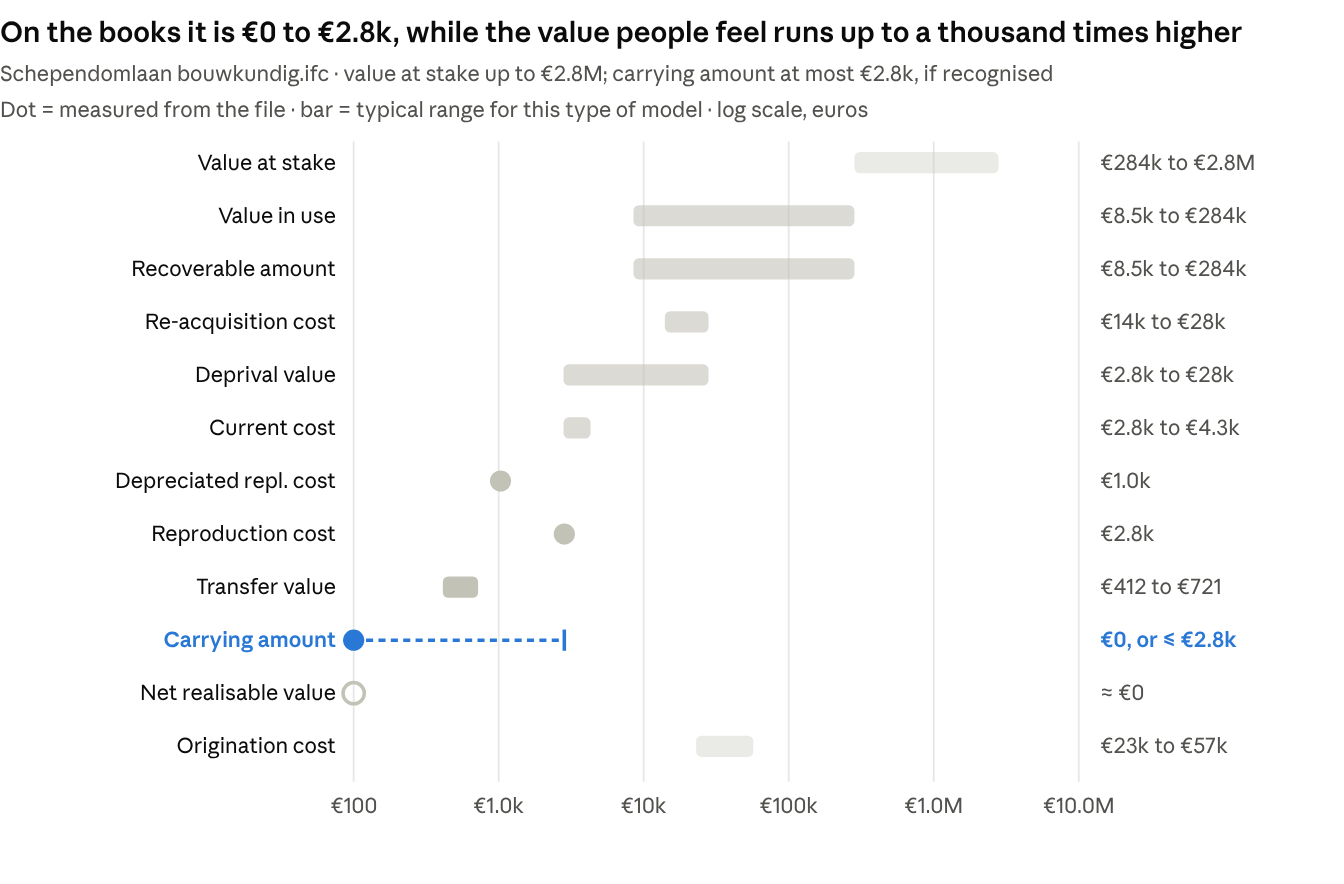
The file is the architectural model of 10 Appartementen Schependomlaan. forensicBIM measures 33.4 hours to rebuild it with the answer known, €2,836 at a blended €85 an hour. After deductions for gaps in its data and its age, its depreciated replacement cost is €1,030. Three independent BIM specialists put the rebuild at about 38 hours, inside the model's likely range.
Everything a controller can book (the blue row) sits at the far left. What people have in mind when they say “data is gold” sits to the right: value in use up to €284k and value at stake up to €2.8M. That distance is the gap between what accounting measures and what the data does for its holder.
Example 2: four models compared
| Model | Elements | Rebuild hours | Reproduction cost | Depreciated replacement cost | Transfer range | Value in use (typical) |
|---|---|---|---|---|---|---|
| Schependomlaan bouwkundig (apartments) | 3,635 | 33.4 h | €2,836 | €1,030 | €412 to €721 | €8.5k to €284k |
| S1 Constructie (structural, high-rise) | 1,363 | 16.2 h | €1,374 | €760 | €304 to €532 | €4.1k to €137k |
| iDNova OBK-Bruggen (bridges) | 491 | 12.3 h | €1,044 | €937 | €375 to €656 | €3.1k to €104k |
| iDNova OBK-Gebouw (building) | 7,363 | 78.8 h | €6,699 | €5,948 | €2,379 to €4,164 | €20k to €670k |
Figures are from the forensicBIM Valuation tab, valued 25 September 2026 at €85 an hour. Later model versions move the hours by a few per cent but leave the orders of magnitude unchanged.
Even the largest of these models, a building with more than 7,000 elements, has a measured cost below €7,000. Its value in use can be a hundred times that.
Example 3: what the controller actually books
A municipality takes over a €15M sports hall. The design team's fee was 10%, €1.5M, and it is already capitalised in the building's cost under IAS 16 (or GASB, or RJ). The facility manager wants the IFC model on the balance sheet “because it is worth a fortune”.
- Decide what can be separated. The contracts do not price the model separately, and the design fee pays for a design recorded in drawings, specifications and the model alike. The defensible slice for the data is its reproduction cost, say €5,000, and it may never exceed what was actually paid.
- Recognise and amortise. €5,000 moves from the building to an intangible asset. Over a 20-year useful life that is €250 a year of amortisation.
- Test for impairment. Each year the carrying amount is compared with the recoverable amount, which without a market is value in use. While the model is maintained, value in use is far higher and nothing is written down. If the model stops being updated, value in use falls and the €5,000 may have to be written down.
- Check thresholds. Many public bodies only capitalise intangibles above a set amount, so a €5,000 model can still end up expensed.
The balance sheet does not grow by €1.5M, nor by the €100k+ in maintenance savings the model may enable. It shows €5,000, falling by €250 a year.
Example 4: why a buyer will not pay “what it is worth”
A concessionaire hands a motorway bridge over to a new maintenance contractor. The outgoing party argues the models are worth €500k because they steer a €50M maintenance programme. The incoming contractor's maximum is its own alternative: scanning and surveying the bridge, perhaps €40k, minus what it will spend to check and convert the files. With no market to set a price, the deal lands near that alternative. The €50M programme is value at stake, and no buyer pays for that.
Where the real value sits, and how to argue for budget
BIM data pays off through lower costs in the profit and loss account and adds little to the asset side. Make the budget case on that basis and keep the two stories separate.
| Purpose | Number to use | Why it holds up |
|---|---|---|
| Put the data in the asset register | Carrying amount, starting from the attributable cost or reproduction cost | Follows IAS 38 / GASB 51 / RJ 210; auditable |
| Justify a yearly maintenance budget | Value in use: avoided surveys, faster inspections, fewer failures over the useful life | This is where the money is; it is an operating saving |
| Explain what losing the data would cost | Deprival value, or re-acquisition cost once the asset is built | Answers “what if it is gone?” with a cost you can price |
| Show why leadership should care | Value at stake | Shows the exposure the data governs, clearly labelled as exposure, not worth |
| Agree a price with a successor | Transfer value | The buyer's alternative, less checking and conversion |
Practical points:
- Recognition is still worth doing. A small carrying amount gives the model an owner, a useful life (often 20 to 30 years for buildings, up to 50 for infrastructure) and an annual impairment test, which asks every year whether the data is still kept current.
- Maintenance is an operating cost. Keeping the model in step with the asset is normally expensed, so the budget line belongs in the maintenance plan, argued from value in use.
- Unmaintained data loses value quickly. Once the model and the built asset diverge, value in use drops and the carrying amount may have to be written down, while re-acquisition cost keeps rising as fabric is covered up.
- IFC protects the value. Data in a proprietary format can drop to zero when the software is no longer supported. IFC keeps the data readable for the full useful life that the amortisation period assumes.
Common misconceptions
That is value at stake: the money that depends on the data being right. A contract does not make its model worth the contract sum, any more than a signed treaty makes the pen valuable.
The fee paid for the design: solving the problem and recording it in drawings, specifications and the model. That cost is already inside the building's cost. Only a directly attributable slice can be separated for the data.
Only in part, and not everywhere. Self-made data is internally generated: only the hours spent in the development phase can qualify, US GAAP and Japanese GAAP mostly expense them, and Austria and German municipalities do not allow self-made intangibles on the balance sheet at all. Where they can be capitalised, Germany, the Netherlands and others restrict dividends against them. A model handed over by a designer or contractor does not face these limits.
Not upwards. IFRS, IPSAS, AASB 138, FRS 102 and the EU national GAAPs allow revaluation of intangibles only with an active market, if at all, and US GAAP, GASB, J-GAAP and CAS 6 not at all. An expert valuation can support an impairment test or a transaction price, not a write-up.
Mostly they do not. Their data value shows in their market capitalisation and in goodwill after acquisitions, not as a separately booked data asset. When a company buys another, acquired data can be recognised at fair value under IFRS 3, but that is a purchase-price allocation, not an option for data you produce yourself.
The booked figure is low because of how accounting measures, and says little about how much the data matters. The case for maintenance rests on value in use, which can be many times higher.
Recognition starts an obligation: amortisation every year and an impairment test whenever there are signs the data is out of date. Unmaintained data has to be written down.
Sources and further reading
- IAS 38 Intangible Assets, IFRS Foundation
- IAS 16 Property, Plant and Equipment, IFRS Foundation
- Intangible Assets project, IASB work plan
- IFRS vs US GAAP: Intangible assets, Deloitte DART
- Internally generated intangible assets under GASB 51, Georgia State Accounting Office
- BW2 art. 365, immateriële vaste activa, Dutch Civil Code
- Directive 2013/34/EU on annual financial statements (EU Accounting Directive), EUR-Lex
- HGB § 248, Bilanzierungsverbote und -wahlrechte, German Commercial Code
- KommHV-Doppik § 72, Bavarian municipal budget regulation
- Bilanzierung immaterieller Vermögensgegenstände, Austrian Economic Chamber (WKO)
- Companies Act 2006, section 844, UK legislation
- Non-investment asset valuations: workstream update, Financial Reporting Advisory Board, HM Treasury
- Accounting Standards Board of Japan (J-GAAP)
- Accounting of enterprise data resources in China, IFRS Emerging Economies Group, May 2024
- AASB 138 Intangible Assets, Australian Accounting Standards Board
- Tijd voor introductie van digitale vaste activa, John Weerdenburg, Accountant.nl, January 2023
- forensicBIM Knowledge Base: The Eleven Numbers, and the Valuation tab of each model's details page